

See It, Solve It Corners: Structured Problem Solving – A Practical Guide for Healthcare Staff
Every operational NHS team faces challenges — from patient flow bottlenecks, late theatre starts, outpatient clinic effectiveness to communication breakdowns and rising demand. These pressures are real, persistent, and often feel overwhelming. But problems, approached with the right mindset and method, are not just obstacles; they are opportunities.
See It, Solve It corners are designed with exactly this in mind. Practical to set up and straightforward to run, these sessions require no specialist facilitation — they are owned and led by the team itself. That matters. When your staff identify a problem and work through it together using a simple structure, they build both the solution and the confidence to tackle the next challenge without waiting for external support. Over time, this engenders a genuine improvement culture: problems are surfaced early, addressed promptly, and resolved by the people who understand them best.
See It, Solve It Corners also pair particularly well with the Strategic Alignment and Transformation Deployment framework. Where the framework sets the direction — defining organisational priorities and cascading goals. Frontline staff act on those priorities day to day and incorporate See It, Solve It Corners to problem-solve issues that are impeding progress. Together, they connect strategy to practice, ensuring that improvement efforts are both structured from above and driven from within.
See Problems as Opportunities
A problem signals a gap exists between where you are and where you want to be. Rather than viewing this negatively, skilled teams use problems as the starting point for meaningful improvement. When a department repeatedly misses a target or a process consistently fails, it is telling you something important — and that information, properly analysed, can drive lasting change.
Address Problems with Evidence, Not Opinion

One of the most common pitfalls in healthcare improvement is allowing problems to be ‘solved’ through opinion, hierarchy or habit. When solutions are based on what people think is happening, rather than what the data shows, interventions frequently miss the mark, wasting precious finite time, resource and goodwill.
‘See It, Solve It Corners’ facilitate structured problem-solving that replaces subjective debates with objective analysis. It asks: what does the evidence actually tell us? Only then do we move to solutions.
Deliver Long-Term Solutions
Quick fixes address symptoms. Structured problem-solving addresses root causes. By investing time and effort upfront to understand why a problem exists, your teams can build solutions that are durable, sustainable, and less likely to resurface, freeing up much-needed ‘free’ capacity in the long run.

Build a Culture of Structured Thinking
When your staff learn to think in a structured way, the benefits extend well beyond any single problem. Your team becomes more confident, more collaborative, and more capable of tackling future challenges independently. Problem-solving becomes a skill embedded in everyday practice — not just a one-off project. It is arguably the key foundation for a learning culture and organisation.
What is a See It, Solve It Corner?
A See It, Solve It Corner is a structured, facilitated process that brings together the right people to move from problem to solution methodically. It is not a meeting where opinions compete; it is a working session built around data, analysis and shared decision-making. Visual management is another key central component and adds the ‘corner’ element. You should encourage your teams to set up their problem-solving corner within, or very close to, where they conduct operational activities. This allows colleagues to view, take part in and stay informed regarding progress on a specific issue under review.
The process follows six clearly defined steps:
Step 1: Define the problem and set objectives

Before anything else, your team must be clear on what problem they are actually trying to solve. Vague problem statements lead to vague, weak solutions. At this stage, ask:
- What is driving current performance trends?
- What exactly do we want to improve?
- By how much and by when?
A well-defined problem statement, supported by data, sets the foundation for everything that follows. Get this wrong and it can become all to easy to go off at all sorts of unhelpful tangents. This results in wasted time and effort. Worse still, it leads to frustration about why things don’t seem to get any better.
Step 2: Analyse Root Causes
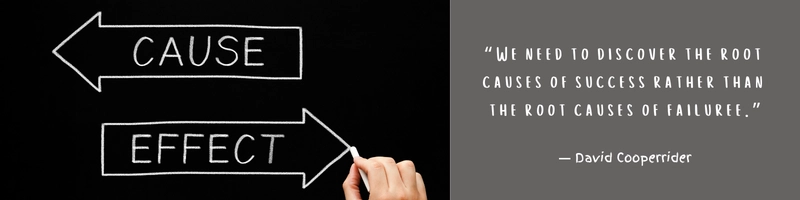
After clearly defining the problem, the focus shifts to understanding its causes, rather than just its apparent manifestations. This means distinguishing between symptoms (what you see) and root causes (why it is happening). Key questions include:
- Where should you look?
- What are the symptoms, and what lies beneath them?
Two powerful tools support this step:
- Fishbone Diagram: A visual tool for exploring multiple potential causes across different categories (e.g. people, process, environment, equipment). Particularly useful when several factors may contribute to the problem simultaneously.
- The 5 Why’s: A simple yet powerful technique that drills down from the problem statement by repeatedly asking ‘Why?’ — typically five times — until the root cause is revealed. Best used once the problem has been clearly defined.
Step 3: Identify Potential Solutions
With the root causes understood, your team can now generate potential solutions. Importantly, this step encourages the team to think creatively and without constraints before they apply practical ones. Useful prompts include:
- If time and effort were no object, what would you do?
- If permission were not an obstacle, what could you still do?
- What further obstacles require addressing?
Brainstorming is an effective method here. By separating idea generation from judgement, it promotes creativity, includes all voices, and ensures ideas belong to your team — not any one individual. This builds collective ownership of the solutions that emerge.
Step 4: Prioritise and Plan Implementation

Not all solutions are equal, and not all can be implemented at once. This step brings structure to decision-making using a prioritisation matrix that plots solutions against two criteria:
- Impact: How significantly will this address the original problem?
- Ease of Implementation : How much effort, cost and stakeholder engagement will it require?
Solutions that score high on impact and ease become immediate priorities. From here, a simple action plan is developed: who will do what, by when and alongside what other commitments?
Step 5: Implement the solution

With a plan in place, the focus turns to execution. This phase is straightforward in principle — just do it — but requires actively tracking progress to ensure you maintain momentum and identify any emerging issues early. Having regular check-ins against the plan keeps delivery on track.
Step 6: Evaluate results and standardise

The team implements the solution and then returns to the data. Key questions at this stage are:
- Did the solution work – have we achieved the objectives set in Step 1?
- Is the solution applicable to other areas within the organisation?
- Has the team successfully embedded the solution as standard practice?
Standardisation locks in improvement. Without it, your team risks reverting to old ways — especially as staff change and pressures shift.
Supporting Tools: The A3 Template
For each problem, the A3 template provides a single-page framework that captures the entire problem-solving journey — from problem definition through to evaluation. The A3 template’s six steps directly map onto the A3, ensuring you document, make visible, and easily communicate your thinking to others.
The A3 is not just a record-keeping tool. It is a thinking aid that keeps teams focused, structured, and aligned throughout the process. It also makes the work shareable, enabling peer review, leadership oversight, and organisational learning.
The Benefits of Efficient Problem Solving
When your team adopts structured problem-solving consistently, the results go beyond fixing individual issues. The broader benefits include:
- Reduced time wasted on recurring problems that have not been properly resolved
- More confident, empowered staff who feel equipped to drive improvement
- Decisions grounded in data rather than assumption, seniority or the loudest voice
- The process includes all voices, which leads to greater engagement across teams
- A culture of incremental, continuous improvement that strengthens over time
Ready to get started?

Using See It, Solve It Corners is a skill — and like any skill, it develops with practice and support. Whether your team is tackling a specific operational challenge or looking to build improvement capability more broadly, the six-step process outlined here provides a reliable, evidence-based framework to get results.
If you would like to explore how See It, Solve It Corners could work in your organisation, we would be delighted to help. Our consultancy specialises in supporting NHS teams to build the skills, confidence and systems needed for sustainable improvement.
Get in touch to find out how we can support your team.
Try the tools yourself — start with a problem your team is facing today, work through the six steps, and see what the process reveals.
